
A brief teaching on the "New Apostolic Reformation"
Over the last few weeks there has been quite a lot of mention of the NAR - the New Apostolic Reformation Movement. Some of this has happened because of the exposure of Shawn Bolz’s fraudulent prophetic activities, and the initial response of Bethel Church. We thought it might be helpful to give you our understanding of what the NAR is, and how we - as Vineyard - intersect with them.
Mapping Vineyard and NAR
In the 1980s Fuller Seminary Professor C Peter Wagner did pioneering work in the area of church growth. He was an unusually humble, pragmatic man who was willing to lay aside his Western cultural assumptions and learn from the rapidly growing churches in the Global South.
Two of his major learning points were:
Most of the fastest growing churches are Pentecostal churches who have rejected bureaucratic governance structures. Such freedom has enabled Spirit-anointed leaders to pioneer new ministry forms that actually work.
Mission that includes signs and wonders leads to significant growth.
Through Wagner’s interactions with John Wimber (Vineyard first global leader), these two learnings became highly influential in the creation of Vineyard Philosophy of Ministry. We both sought to remove barriers to Senior Pastors making spirit-filled, mission-driven decisions and we encouraged the church to embrace faith as r-i-s-k, particularly in stepping into Power Evangelism. Church analysts described these Vineyard-type of churches that emerged in the 1980s Third Wave churches. The First Wave of Charismatic/Pentecostal Movement was Asuza street birth of Pentecostalism and the Second Wave was the charismatic renewal in the catholic and traditional churches of the 1960s.
As Wagner grew older, he became increasingly focused on finding anything that he thought might lead to faster growth of numbers. And this led him to increasingly advocating for three major practices:
That the church should stop being so focused on Pastors and Teachers and instead celebrate Apostolic leaders (with a capital “A”) who will focus not on seeing individual believers being discipled in their churches but on influencing and winning whole people groups, or even whole nations
That these “Apostles and Prophets” must be freed up totally from church-based governance structures which often quench the move of the Spirit.
These Apostles and Prophets should lead the church into Strategic Spiritual Warfare where prayer and fasting identifies and then binds up territorial spirits who are preventing revival coming to whole regions.
Wagner began to gather people around him who agreed with these 3 new ideas for how to organise church, calling them the New Apostolic Reformation (NAR). The NAR banner was not universally used, but effectively a “Fourth Wave” of the Pentecostal/Charismatic Movement emerged; one which pushed for Apostles to break free from accountability structures, for Prophets to discern where the next great revival could break out, and where their networks would then be harnessed to bring Spiritual authority to that situation in a dynamic move of global impact. Bethel, IHOP, Harvest International Network, and in some people’s opinion, Hillsong were considered to be NAR-type churches.
Distinguishing between New Paradigm Churches and Independent Network Christianity
In their book “The Rise of Network Christianity” academics Brad Christerson and Richard Flory express a conviction that the underlying theology of NAR-type churches is actually fundamentally different from Vineyard-type churches. They have identified the following significant differences:
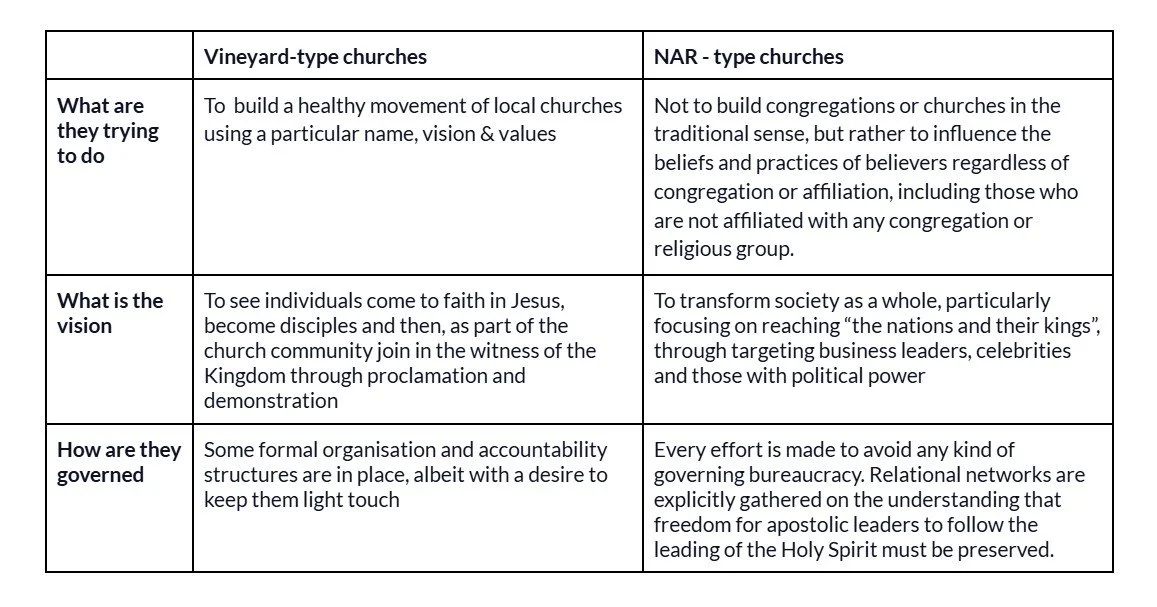
Three things we can learn from the NAR and three serious questions we want to ask
We in Vineyard want to acknowledge that we have a huge amount to learn from the NAR-type churches:
They have fully embraced leaders from the Global South and have been willing to learn from them. In particular they seem to have an instinct for healing, deliverance, power anointing and prophecy that warrants our attention.
There is no desire at all to be apologetic about success or big visions. Every event and every communication is intentionally focused on inspiring, empowering and equipping the attendees to have more Kingdom impact. This is inspiring and gives permission to entrepreneurial people.
They have understood the power of online communications and great marketing. They actively produce content and stories aimed at catalyzing their members.
But there are three serious concerns we have with the NAR practice. Naming these can help us ensure we as Vineyard-people are actually getting our own house in order in these ares:
Christerson and Flory use a helpful analogy for the NAR; they say they are like the Christian church’s version or Airbnb or Uber; a centrally branded, global opt-in-opt-out network full of driven and creative “partners”. This laissez-faire approach to governance can free up creativity in leadership, but that same laissez-faire approach can lead to a very transactional type of church where leaders are no longer part of the communities they are serving, and where attenders / recipients of a “ministry” have no bond to others present. In Vineyard we should be asking ourselves whether our engagement with church has become transactional, or whether we are genuinely seeking to form communities who bear one another’s burdens and to stick around with others even when things start to get tough.
While Christerson and Flory are correct to some extent in their comparison between NAR and AirBnb, what distinguishes these groups is the place of “reviews”. AirBnb’s model relies heavily on customer reviews helping others make discerning choices. But the NAR model comes with significant power for Apostles and Prophets to write their own - or one another’s - reviews, and to give no space to the experiences of those who are on the receiving end of their ministries. The spiritual weight of naming someone as an Apostle or a Prophet, along with a strange Culture of Honour that is pushed as being the appropriate way to speak about such people, only adds to this danger. In Vineyard we should be asking ourselves not only whether we want to pursue a way of church that splits communities so starkly as either “Leaders” or “recipients” (by whatever language we choose) but also who in each local context is empowered to genuinely question, rebuke, endorse and disciple those who are charged with leadership.
And thirdly we have serious questions about the practice of Strategic Spiritual Warfare, being directed by people named as Apostles and Prophets. While we must surely want to emulate the desire of NAR leaders to see thousands come to faith and whole communities and nations redeemed, it feels dangerous when any churches “fighting in prayer” is steered by one or two individuals, is primarily against a specific demonic power, and is unto a type of “top-down Revival” that is hard to find in the scriptures. As Vineyard people we should be asking ourselves both whether we can find the radical middle of both leaning very hard into intercessory prayer, and into deeply valuing the grubby reality of eating with sinners and helping ordinary, politically unimportant people grow each day a bit more like Jesus.
The truth is that even if we can grab hold of all that is good about what the NAR carries, and can address these three concerns, leadership failures will still happen. Until Jesus returns we will continue to see people (even church leaders) do people stuff. But our sense is that if we can build churches where there really is community, not just transaction, and where there is a range of people empowered into leadership in the local setting, and where we can hold the radical middle in intercessory prayer, then we can continue to see the Kingdom of God extended in our midst, and leadership failures can be more quickly identified and dealt with.